


I wrote this post in 2013 and am updating it a smidge here.
In 2011 or -12, while I was director of communications and engagement for the Columbia Association and reporting directly to the CEO, I was tasked with a hard-to-do-overnight goal: to increase the pool of people interested in running for local elections in the community.
As some know–and many don’t–the Columbia Association (CA), which “manages” Columbia, Maryland–is a 501(c)(4) service organization that manages the master-planned community of Columbia with its 100k-or-so residents, several thousand businesses and about $85 million in annual revenue and $75 million in annual expenses.
While the relationship between Columbia and CA is more complex story to share than I’m going to do here, in short, there are 10 villages that function as HOAs for the properties within their bounds: each with a budget, staff, facility or facilities, committees and volunteers, and an elected board of directors.
Each village also elects a representative to serve on the Columbia Association’s board, which is supposed to provide direction to the organization and oversee the president.
It’s a system that works sometimes, though often sucks.
pettiness and power
One of the prime reason is often sucks is Who. (Ain’t that just always the truth?)
Not uncommon to local elections for small organizations, the villages often have to beg for candidates and for enough voters to vote to meet legally mandated quorums.
And not uncommon to local elections, the Single-Issue Candidate arises. Or someone with little capacity to fulfill the actual role, or with parochial attitudes that have them more focused on their NIMBY-ness than the needs of the people and organization they serve. But I shan’t go into that rant … though I could.
During my time at CA, the CA board–as was unfortunately and often the case–was a mess of contention, infighting and Tiny Tyrants. It was disastrous for the organization, for morale among the staff, and trust among the community.
For while one Tiny Tyrant can wreak havoc, several Tiny Tyrants can do so much more damage and can, essentially, derail an organization.
The CEO to whom I reported (an “outsider” and one who had not grown up or lived decades in Columbia) could clearly see this mess. And he knew a bit about local leadership.
people want to serve, but few want to run
The CEO told me a few key points about local leadership:
- Very few people want to run for local elections, but many people are happy to serve. (The campaigning and all is too much for some.)
- Many people who do rise up into greater positions of elected leadership, over the years and decades, often start out in rather small roles: perhaps as a PTA committee member, or on the local swim team’s fundraising committee.
- It’s often the crazies and single-issue voters who have the passion to run, but they are often the worst choices for being able to serve on a board–with its many aspects of responsibility, as they have little experience, or have little interest in actual service beyond their parochial views.
my mission: increase the pool; decrease the crazies
What the CEO wanted was a larger pool of candidates. More people who were interested in moving up and into local leadership. More people who wanted to serve at the village level, and then perhaps at the CA level.
And fewer crazies. Fewer Tiny Tyrants.
what our amazing team did
Now, I have ADHD, love solving a puzzle and do well in complex situations. So I knew how to begin to address this issue, and I had a great team to help implement the vision.
In 2012, this is what the communications and engagement team did to begin promote leadership opportunities.
Created a get-involved website
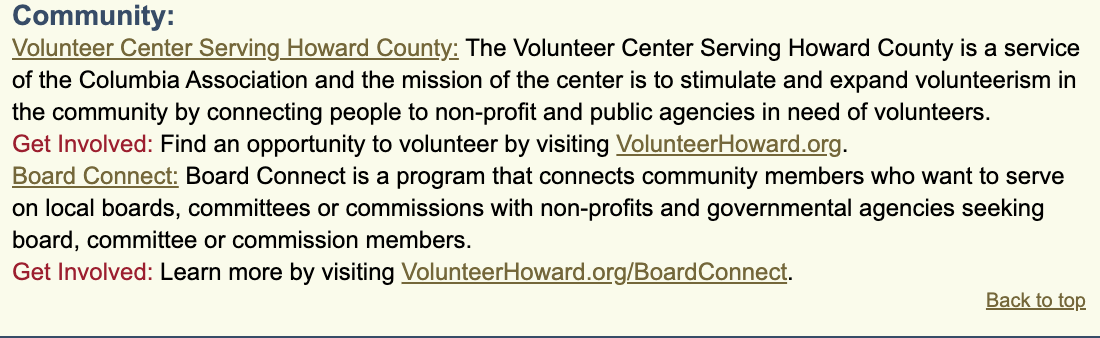
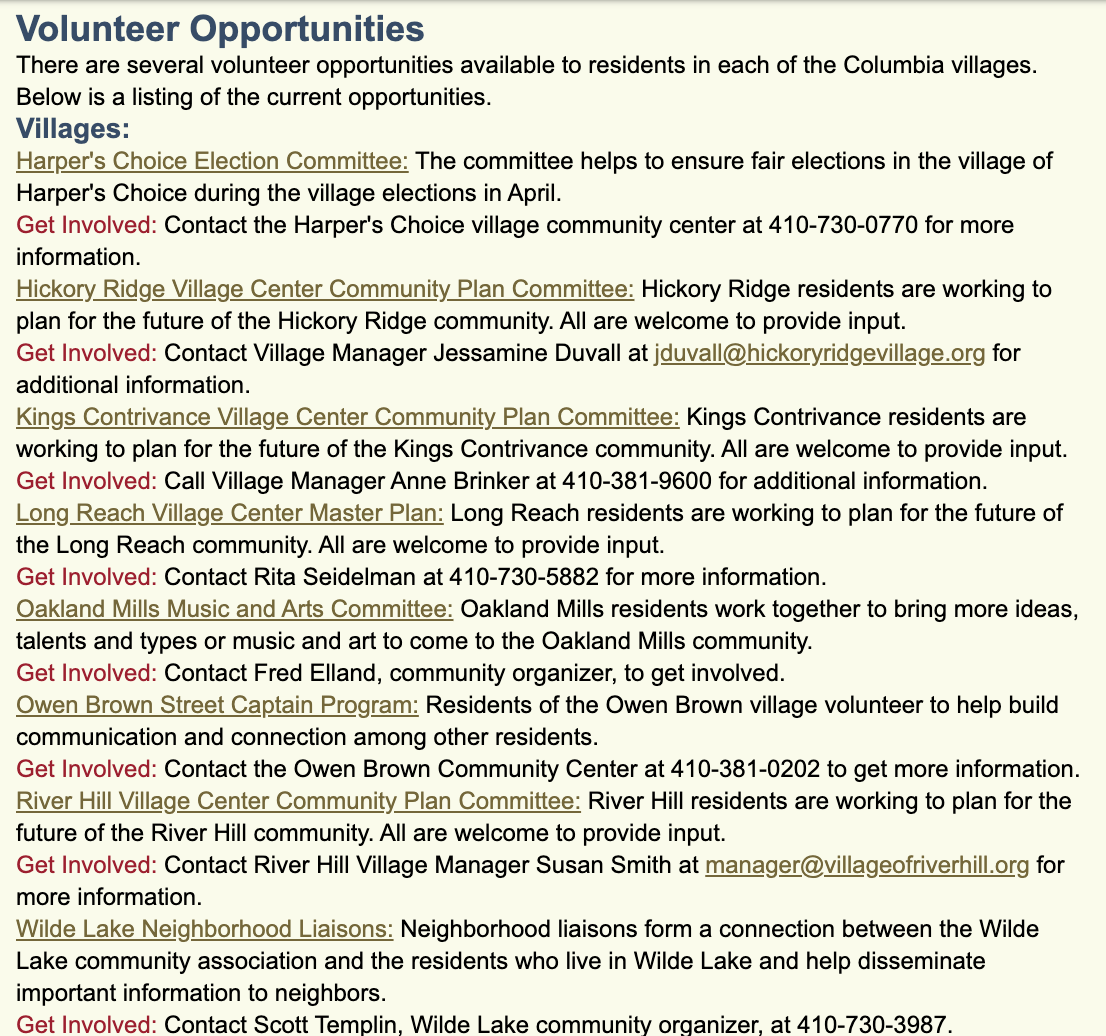
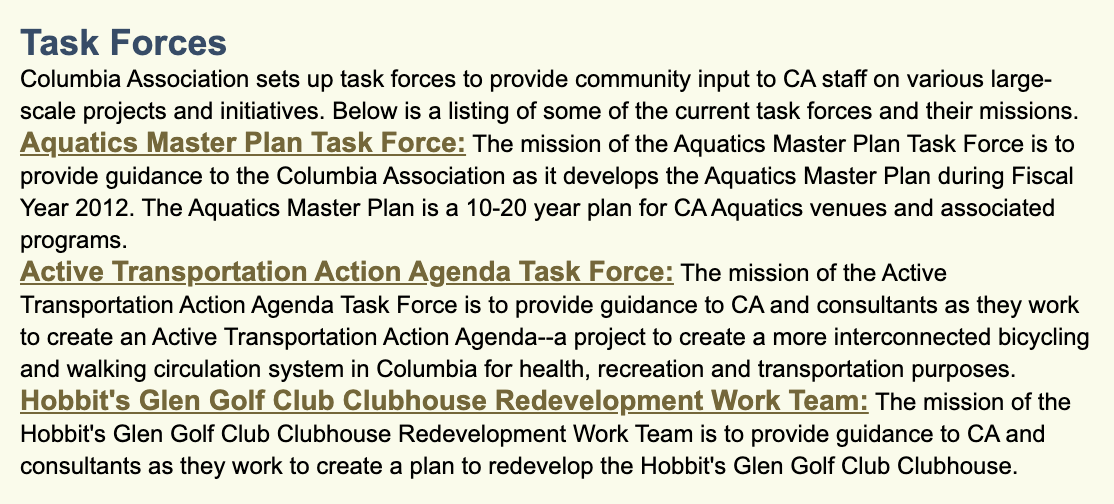
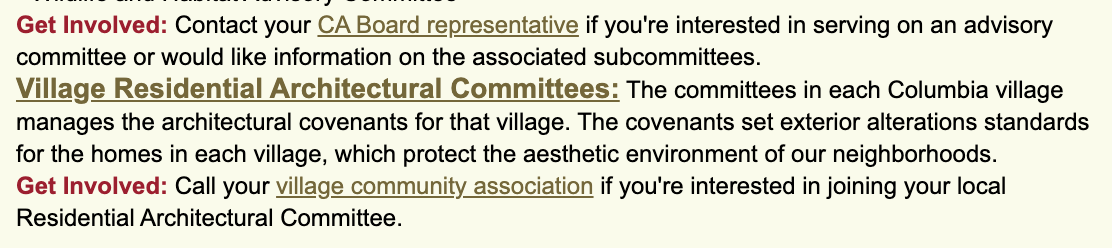
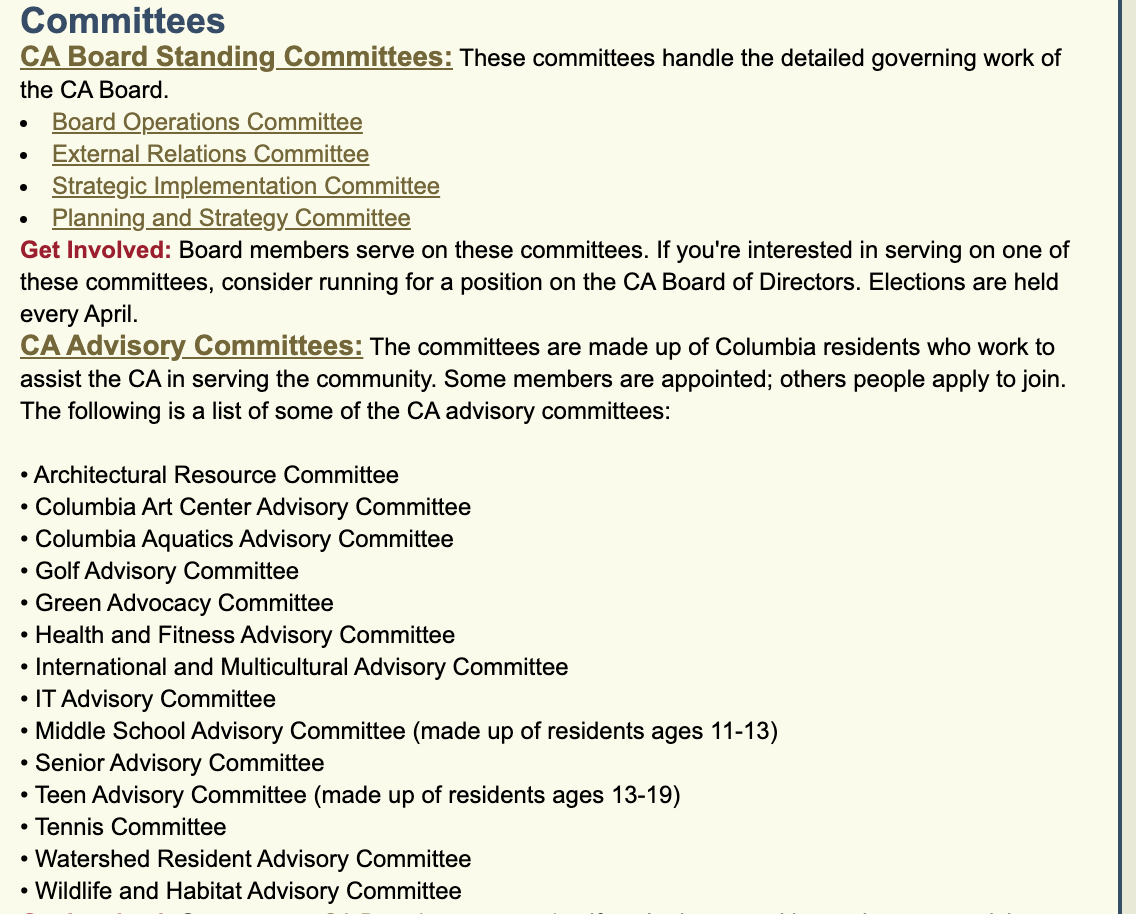
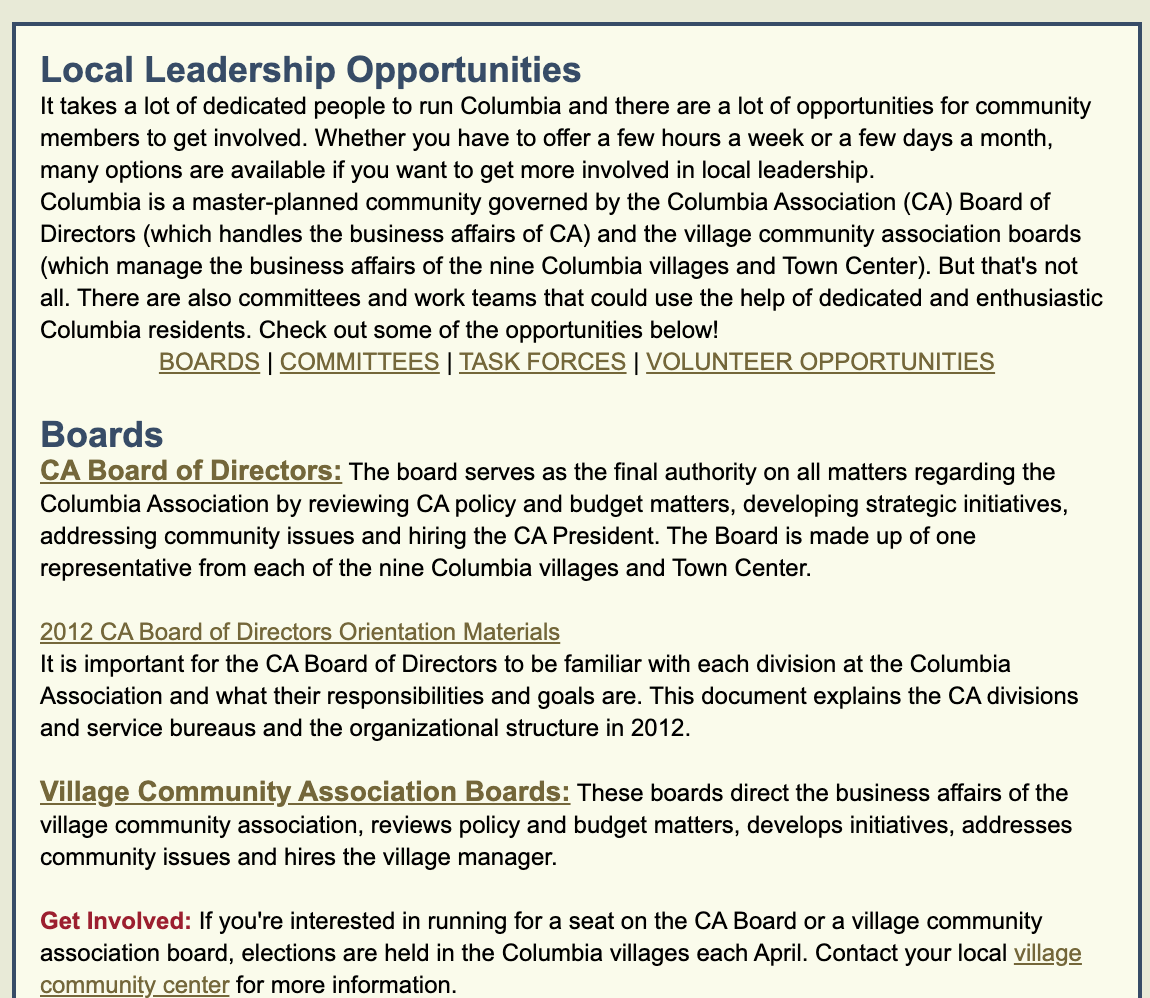
We created a website focused on local leadership opportunities in the villages and CA. We gathered every single leadership opportunity we could identify at the village and CA level, wrote about them, offered links for more info and then spread that info far and wide. (Note, CA long-since deleted this page, but here it is via the Wayback Machine. I’ll add screen caps at the end of this post.)
Ran several pre-election articles to inform the public
We wrote and ran several pre-election articles in the CA Monthly (delivered inside the Columbia Flier to every residence and business in Columbia) about the elections, getting involved, dates for filing for candidacies and voting locations; followed by post-election articles about the new CA board.
Ran large, visible, community-wide ads
We frequently ran a full back-page ad in the Columbia Flier encouraging people to vote and get involved in local leadership opportunities.
We also reached out to the business community with ongoing ad in The Business Monthly and other pubs encouraging business-oriented folks to get involved as candidates, volunteers and/or voters.
While this may seem NBD in 2026, in 2012 it was: We ran Facebook ads to the same effect, hoping to reach (at that time) a younger audience as well.
Created an insert mailed to every home and business
We created a compelling, separate “get involved” printed piece that was inserted in the annual assessment-fee bill physically mailed to every homeowner and business in Columbia.
In that mailing was also the annual report, called CA at Glance, and in there we added a two-page spread on leadership opportunities.

created videos highlighting leadership opps
Yeah, yeah, you created a video. So what? Well, in 2012, it was more than a so-what. It was compelling and it helped us reach a larger audience.
used all channels possible
 We did it all. Our team planned and executed a significant communications campaign across all of its online communication channels — multiple Facebook and Twitter accounts, the monthly TV show shown on Comcast, YouTube videos and Comcast PSAs.
got the villages involved
We shared the election-focused PSAs and articles with the villages and encouraged them to promote the videos, the leadership-focused website and other relevant content.
shared stories of other local leaders
We ran a year-long “Why I Serve” series of articles n the CA Monthly (the 8-page printed newsletter inserted in the Flier), in which people serving on village boards, CA committees and the Columbia Council were highlighted;
focused on the micro opps
We embarked on an extensive campaign to increase the press releases, ads, announcements and community outreach to announce various committee and leadership opportunities that don’t require a campaign or election, such as —
• Columbia Art Center Advisory Committee
• Columbia Aquatics Advisory Committee
• Golf Advisory Committee
• Green Advocacy Committee
• Health and Fitness Advisory Committee
• International and Multicultural Advisory Committee
• IT Advisory Committee
• Middle School Advisory Committee (made up of residents ages 11-13)
• Senior Advisory Committee
• Teen Advisory Committee (made up of residents ages 13-19)
• Tennis Committee
• Watershed Resident Advisory Committee
• Wildlife and Habitat Advisory Committee
• Architectural Resource Committee
Knowing that many people start small then move up the leadership ladder after starting out in volunteer committees, we went out of our way — way out of our way — to publicize the micro opportunities.
used the Howard County Board Connect site
We listed — and encouraged village managers to list — any board and CCR positions on Volunteer Howard’s (now a county function) Howard County Board Connect site, a site dedicated to sharing local board and leadership opportunities.
educated and empowered village managers
As village managers are the front line for super-local leadership, we helped them do better. We shared CA’s leadership-focused communications plan with the village managers, held communications and technology workshops for them, and encouraged them to use CA’s materials and “path” as a guide.
stimulated citizen engagement and communications
Our team designed and offered numerous free, well-publicized Lunch & Learn sessions about social media, communications and citizen engagement (it was 2012!) to which all the village managers, their staff, their volunteers and their boards were invited.
made systemic changes
The tools, the ads, the plans, the strategies, the systems and the knowledge for how to rock communications about the village elections, getting involved in local leadership and voting were shared throughout CA’s teams, committees sand community-leadership touch points, and they were shared with the villages.
alas, it takes a leader to nurture more leaders
I left CA in 2012, the CEO left shortly after; and the next person in my role and the next CEO didn’t seem to think this “more local leaders” campaign was important to do, so all that we had built was tossed aside.
But, and really, we need fewer Tiny Tyrants and more people who can step into local leadership. And to get that, CA–and the villages–has, imo, a responsibility to get that message out … again and again, year after year, whenever and however they can.
May this post and these actions we took serve as a starting point for those willing and able.
fwiw – CA’s 2012 website focused on getting involved